Friday, March 30, 2007

Connections for Dummies

There are many varieties of connections between audio components. Some are better than others, and while they may look similar, it's important to know the difference. Using the wrong connection between audio components, also called an "interconnect", will cause a loss of signal due to impeadance mismatch at best, and at worst cause damage to one or both components.

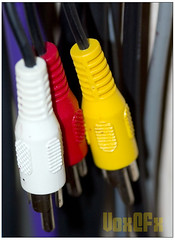
The most common type of connection is between "line-level" components, and usually uses RCA plugs. These connections are ordinary sine waves with an amplitude of roughly one volt, though in car audio equipment this may vary. These are basic connections which take analog audio - usually before volume adjustment, and are sometimes used for video, too, as is shown in the left/right/video "composite" connection shown below. (Red is almost always right, white is almost always left, and yellow is almost always a TV connection - though they're all the same cable.)
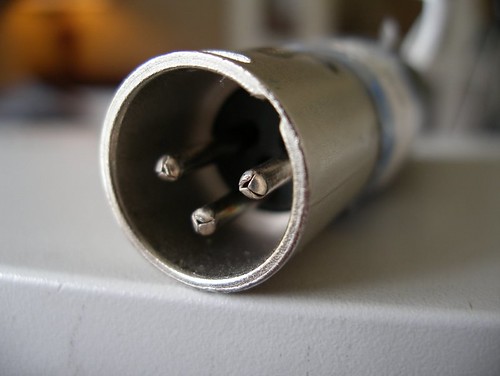
In addition, there are also "balanced" connections, which feature two leads and a ground, usually intertwined. Because the two "hot" leads are exactly out of phase, any RF is almost entirely cancelled out. For this reason, balanced connections are very popular for "pro" audio usage and in cars. These usually use a three-connection XLR plug.


Another type of common connection is the S/PDIF digital audio link. S/PDIF is the traditional format of connection between digital audio components and DACs, and can carry multiple channels of audio with a single cable. It's generally advised to use one of these to connect your DVD player to your home-theater reciever, and they're the method of choice for the use of external DACs with a CD player (in this case, you bypass the internal DAC in order to use one of higher quality.)

While S/PDIF uses RCA plugs, the cable itself has a different impeadance, and so it is strongly reccomended that you do not use a normal RCA interconnect for S/PDIF connections. The impeadance mismatch will cause signal loss, which will lower the quality of a digital connection.

Digital audio in S/PDIF format may also be transferred through an optical connection, often called a Toslink connection. These are featured most commonly on Sony audio equipment - most notably MiniDisc players - and the Apple G5 and Mac Pro.
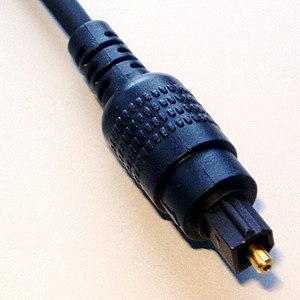


While functionally the same, digital optical cables have a few advantages and disadvantages. First, because they use light instead of electricity, they're totally immune to RF noise, such as that produced in an engine. However, the optical cable, made of glass or plastic, is much more fragile than a stranded copper-wire cable, and if the ends become scuffed or dirty on either the jacks or the plugs, it will cease to function properly. In addition, these cables are generally a good bit more expensive than S/PDIF cables.

And remember, folks - you might just find me on Speakchat.

Thursday, March 29, 2007

Digital audio and you.

Most CD players sound like junk compared to a good turntable, it's true. They're noisy, fuzzy, and just plain unpleasant.

But that's not because of the quality of compact-disk audio. It's because of the player.

Contrary to popular belief, not all CD players are created equal. Unlike a turntable, which converts vibration in the stylus - through a sort of microphone - into an electrical signal, a CD player instead must deal with a constant input of digital data which must be converted to analog in real-time. Most CD players have three parts: The transport, or pickup; the digital-to-analog converter, or DAC, and the output stage. The transport is a mechanical device containing a motor to spin the disc and a laser to read the CD; the DAC turns the digital signal into audio, and the output stage sets the gain and output impeadance to more usable levels.

The first source of problems is often within the optical pickup on the transport. Each "stripe" of data on a CD is only a fraction of a millimeter wide, and the laser which reflects off of it must be very precisely placed. If the laser pickup is unable to read parts of the CD, that data - and hence, music - is lost.
While a CD player is able to by design able to "smooth over" any missing data, large holes will in turn result in reduced quality. While this is not a problem for most modern CD players, a cheap transport in a cheap CD player (not necessarily an old one) will reduce sound quality.

The most common problem, however, is with the DAC. Digital audio is converted using Nyquist's Sampling Theorem, which essentially states that an analog signal can be turned into data by taking its level on a regular basis. Compact disc audio is 16-bit, and hence has 65,536 possible output levels, which are varied between to create an analog signal. The signal changes level over 44 thousand times per second. Both of these are in excess of what most people can discern - but this is meaningless if not all of it is used.

One of the most common tricks for lowering the price of a DAC is "oversampling". By sampling the frequency twice as fast, it's possible to replicate a voltage at double the actual level of resolution (say, 1.5 volts ) by quickly switching between 1 and 2 volts at double the normal sampling speed. While this can do good things for signal quality for high-quality DACs that oversample at an effective 20 bits (standard 16 bits - but eight times as fast!), many cheap DACs are often just 12-bit DACs set to oversample to an effective 16 bits.

In addition to oversampling, some DACs are simply of low quality. These DACs use poor-quality parts or inferior design, and simply do not sound very good. As a rule of thumb, cheap electronics have poor-quality DACs, while better-quality electronics have better-quality DACs. There are many different varieties, though Texas Instruments makes some of the best.


While even relatively inexpensive transports often are more than adequate, built-in DACs are often of low quality in many CD players. AS a result, many CD players sport external S/PDIF digital audio connections for use with recievers that have on-board DACs, or discrete DAC modules. If you have an older-model CD player, an external DAC may be a valuable upgrade.

Finally, it is hard to ignore the output electronics. Some CD players use cheap op-amps and low-quality power filtering, while others use high-quality op-amps and well-filtered power to reduce noise and hum. While it's generally unnecessary to purchase an external power conditioner, a cheap CD player will often pick up more noise than a well-made player.

Wednesday, March 28, 2007

Yet More Helpful Links

Well, I'm in a bit of a crunch, as I need to finish some papers to turn in before the end of the quarter. Hence, more semi-lame filler. More verbose audio goodness should, however, follow after the break.

The following are excellent places to visit if you need help with speakers and audio, and I highly suggest you check them out.

1. Speakchat
Speakchat.net is home of the Speakchat java chatroom. (It's not actually IRC, if you're wondering.) While not the most popular of chatrooms, it's the hangout of a few extremely knowledgable individuals, including WmAx and AndyG. Just click the "chat" button in the upper left, and you're done!

2.DIYaudio
The DIYaudio forums have been for years a major center of all DIY audio building and design. Wether you're into single-driver speakers or complex class-A solid-state amplifers, you'll find a variety of experts on it here. Also featured is a sub-forum dedicated to the excellent work of Nelson Pass, who himself posts there on a regular basis.

3. Audiokarma
Audiokarma is the home of a lot of old-school audio enthusiasts. If you want information on your vintage Halfler amp or need to repair your Pioneer HPM-100's, this is the place to go. It's also a frugal audiophile's paradise - with a little work and combing of Goodwill stores, it's possible to get stereo equipment superior to that sold at Best Buy for a fraction of the price.

4.DIYmobileaudio
DIY Mobile Audio is the hangout of car-audio enthusiasts who do it the right way: using high-quality drivers and custom crossovers. If you want to get a serious sound system in your car without a massive drain on your wallet, this is the place to do it.

5.Parts Express "Tech Talk"
While less formal than the more complex bulletin-board system employed by the other listed forums, Tech Talk is a useful resource nonetheless. If you need a quick question answered - or just want to look at other people's designs - this is a great place to go. Also easily found is information on Parts Express' clearance drivers, and assorted very inexpensive speaker designs based around them.

Finally, feel free to E-mail me any questions you may have. I'm still learning as I go along, but I'll help to the best of my ability.


Tuesday, March 27, 2007

And now, my first original speaker design!

I recently snagged a pair of Neo3PDR tweeters for $60. While the Cryolites are supposed to be excellent, I'd like to go for something a shade smaller.

As a result, I'm going for the Dayton RS150 woofers and active 8th-order crossovers, courtsey of a pair of Alesis amplifier modules. Distortion should be even lower than the Cryolites, and thanks to the impressive off-axis performance of the RS150 and Neo3PDR, I won't need to worry much about a "sweet spot".

To go with them, I'll hopefully get a subwoofer of some sort. The end result will, hopefully, be a system I won't want to upgrade anytime soon.

(Yes, I'm lazy and not posting much today. I need to go to bed.)

Monday, March 26, 2007

So, what's this amplifier jargon mean?

Amplifiers are a vital component - while the loudspeaker reproduces the sound with a varying degree of accuracy, a speaker can only be as accurate as the signal sent to it. While there are an endless supply of meaningless buzz-words attached to almost all amplifiers, there are meaningful numbers as well.

Perhaps the most commonly flaunted number is "watts RMS". This is, very simply, a measure of power - in other words, what would happen if the signal were rectified to DC from an AC sine wave, and the wattage (volts multiplied by ampres) were measured. While there are several other forms of measurement also employed today, such as "music power" or "PMPO", these are almost always meaningless, and should be treated as marketing baloney.

An amplifier's RMS output is usually stated at a given impeadance - for example, 120w into 8 ohms, or 200w into 4 ohms. This is basic electronic physics - current is equal to the voltage divided by impeadance (ohms), and if a given voltage is applied to half the impeadance, the resulting current - and hence, wattage - will double. This only occurs in the best of amplifiers, though: with the exception of some massive Nelson Pass designs, inefficiency and internal resistance within the amplifier - if not simply the internal power supply - will limit output to a bit less than double.

Some cheaply-made amplifiers are only capable of driving an 8-ohm load. While it's usually safe to use them with a 6-ohm load (common on some home-theater speakers), a 4-ohm load will cause too much current to flow through the output transistors on the amplifer - which will, in turn, cause it to overheat and die.

As much as it is flaunted, raw power is not a measure of quality. Much like speaker drivers, amplifiers also have a measurement of distortion - but they must also include residual noise from the power supply and crosstalk. This is abbreviated to THD+N, and is the benchmark for audio quality.

However, there are several tricks in measurement to look out for. First, almost all but the highest-quality amplifiers distort more at higher frequencies; as such, the THD+N is measured at a very low frequency, and this may give misleading results - especially on some cheaply-made class-D amplifiers. Secondly, distortion will often increase as the power output increases - make sure that the THD+N rating is at no less than 1/10th the rated maximum output power, or roughly half maximum volume.

Sunday, March 25, 2007

DIY Loudspeakers Part 4: Return of the Boxes

While speaker drivers and crossovers are very important, they're generally quite useless without a box to put them in. In fact, a woofer's frequency response is determined largely by the box it is used in - without a box, they won't work very well at all.

There are basically five kinds of boxes: Sealed boxes, ported boxes, horns, transmission lines, and open-baffles. Each performs very differently, and each has its own benefits and hindrances.

Sealed boxes, like the name suggests, are air-tight boxes into which drivers are placed. Because there is no way for back-pressure created by the driver to escape, these are sometimes also called "acoustic suspension" speakers. They have a -12db/octave roll-off below the tuned frequency, although this will vary between box and driver. In addition, the lack of other resonant objects aside from the air in the box eliminates potential sources of distortion.

Ported boxes are similar to sealed boxes, except that they have a hole or tube - a "port" - that resonates at a pre-determined frequency. Because this "port" allows a point of resonance of a lower frequency than the box itself, it can help increase response at low frequencies. However, the roll-off is a steep 24 decibels per octave - eliminating some very low frequencies entirely. Furthermore, the port can cause unwanted resonances in the driver, and may cause distortion if not designed properly.

A horn works a lot like the instrument which shares its name: Small at the end with the speaker driver, and large at the other. However, many horns incorporate resonating chambers and reflective sections to compensate for frequency response, making them far more complex than a simple expanding pipe.There are generally two variants of horn: Front-loaded horns, which go on the front of the driver and face towards you, and back-loaded horns, which go behind the driver. While front-loaded horns - which more directly affect the sound which travels to your ears - can cause distortion if built improperly, they are also generally very, very efficient - they work like an old-fashioned megaphone, which despite having no electronic parts can make your voice effectively louder.

A transmission line works like a horn, except backwards. The general concept behind a transmission line is that they are in essence a tube behind the driver, stuffed with a filling- usually some sort of fiber-based fluff. The longer the wavelength, the more fluff a single quarter-wave of the frequency will have to travel through,. The physics and design of transmission lines is very complex, and requires some sophisticated mathematics for modelling them - however, the bass performance of these can be impressive indeed.

Open baffles really are not boxes at all. Instead, they're just a flat plate - a "baffle" - that allows for reflection of sound waves off of it, and prevents vibrations emanated from the front from being eliminated by vibrations from the back. Open-baffle speakers are generally poor in terms of bass performance, as low frequencies have a wavelength long enough that it would require a massive baffle to prevent bass from self-neutralizing. However, so long as they are placed a suitable distance from walls, the lack of back-resonance can eliminate a large amount of distortion. For this reason, open-baffle speakers are very popular, and a mid-woofer in an open baffle is often combined with a woofer in a ported box.

Tomorrow: Baffle step, and what exactly is, anyway.

Saturday, March 24, 2007

The Budget Challenge, Part 1

Recently, I've blown a massive amount of cash on speaker drivers. (When I try something, I always seem to go overboard. It's a fault of mine.)

However, most high-school students (let alone grad students), interns, and thrifty individuals cannot afford the price of even the cheapest of DIY speakers. While a $120-a-pair design might outperform $200-a-pair commercial speakers, there's not much in the $60-a-pair bracket.

While Zaph's single-driver B3S design is an excellent design with a sub-$50 pricetag, the low maximum output and lack of bass make it less than appropriate for "rocking out", as also applies to many other small single-driver designs. And buying "buyout" parts is also impractical- good as they might be, they're not going to be very useful if there are no pre-existing examples to work off of.

As a result, I'm starting a competition of sorts for a reliable, easy-to-build, and cheap speaker design. The catch is that they must have a total driver cost of less than $50 total, and that the drivers must be commercially availible - NSBs don't count. The winner wins a yet-to-be-disclosed grand prize, while the 2nd place winner wins a Linksys WUSB11 wirless adapter. (I have a spare.) 3rd place winner wins a collection of singles on CDs that I have laying around.

So, the rules are as follows:

1. Total driver cost of $50 or less. (A little more than $50 is okay.)
2. Simple crossovers. No more than 2nd order, if possible - this helps keep the cost down.
3. No single-driver speakers, unless they're usable down to 60hz.
4. Reasonably high output level - preferably at least 100 db/1m before clipping.

Ideally, I'd like to see some transmission lines or towers - good bass is priority.

And now, for a few reccomended drivers:

Woofers:
1. Silver Flute W14RC25($17)
This woofer was featured by Zaph in one of his low-end designs, and while I can't tell you much other than that it was a transmission line, I recall that it's been used successfully in another design with the Hi-Vi K1 tweeter ($9).

2. Peerless 830392 5.25" woofer ($10)
Madisound's had these in stock for ages. Peerless is a good brand - for $10, how can you lose?

3. Hi-Vi W4-654 woofer ($18)
While this might be more appropriate for a smaller speaker, its large frequency range means a simple crossover.

4. Dayton DA175 ($18)
This driver offers good performance - and good bass - at a very reasonable price. Far, far better than the dayton "classic" woofer.


Tweeters:

1. Hi-Vi K1 ($9)
An all-around decent performer - and cheap, too!

2.Aurasound NT1-204-8D titanium-dome tweeter($8.50)
This seems to require a somewhat high crossover point (~3khz), but is supposed to perform well.

3. Vifa D19TD05 3/4" soft dome ($15)
I think that this is similar to the tweeter used in the Paradigm Atoms.

4. Vifa D20TD05 3/4" soft dome ($16.50)

5. "Shielded Soft Dome Tweeters" (A.K.A. Meiloon tweeters) ($7.50)
These were used to great effect on the PE board - they're supposed to be quite good.

6. Dayton ND20FB 3/4" soft-dome tweeter ($5)
This driver tweeter offers nice performance at a very low pricetag...above 5khz.